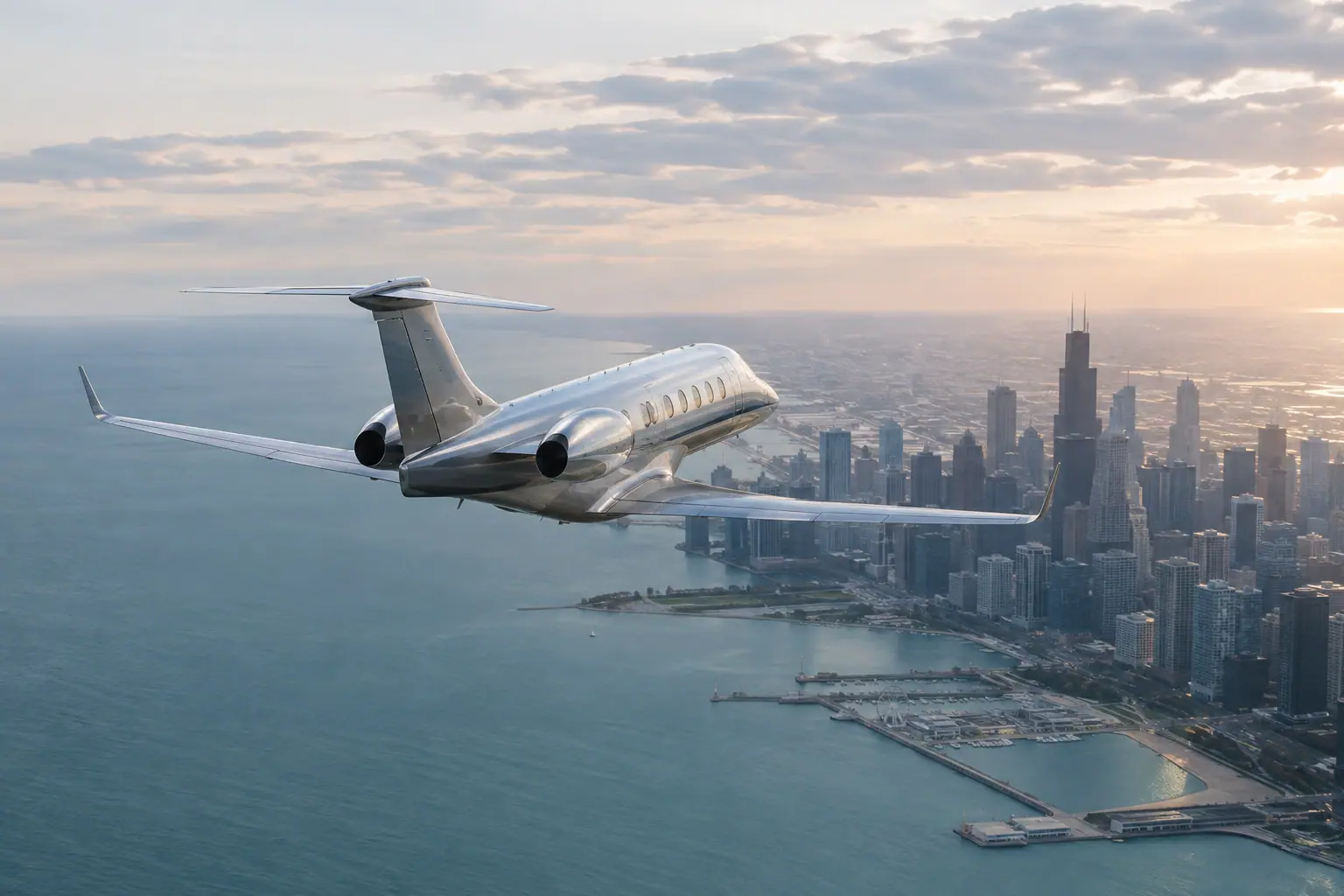
Private Jet Chicago to Austin
Private jet Chicago to Austin covers 832 nautical miles. A light jet flies it nonstop in about 2h 20m, with estimates from $9,000. Here are the airports, aircraft and timing that shape the quote.
- 832 nm957 sm
- 2h 20mlight jet en route
- $9,000–$13,500one-way estimate
Chicago to Austin private jet prices by aircraft
Flying private from Chicago to Austin takes 2h 20m on a light jet over 832 nautical miles, with a one-way estimate of $9,000–$13,500.The table below compares five aircraft classes on the Chicago to Austin route, with nonstop block times and estimated price ranges. Turboprops are the slowest and least expensive; heavy jets are the fastest and priciest. Use these figures to narrow the field before you request quotes from operators.
| Aircraft class | Flight time | Est. one-way price | Notes |
|---|---|---|---|
| Turboprop | 3h 13m | $7,000–$11,000 | No stops |
| Light jet | 2h 20m | $9,000–$13,500 | Best fit |
| Midsize jet | 2h 17m | $12,000–$18,000 | No stops |
| Super-midsize jet | 2h 10m | $15,500–$21,500 | No stops |
| Heavy jet | 2h 10m | $20,500–$31,500 | No stops |
Figures are per aircraft, not per seat, quoted before federal excise tax and segment fees. Block time covers taxi, climb and descent.
Why a light jet fits this trip
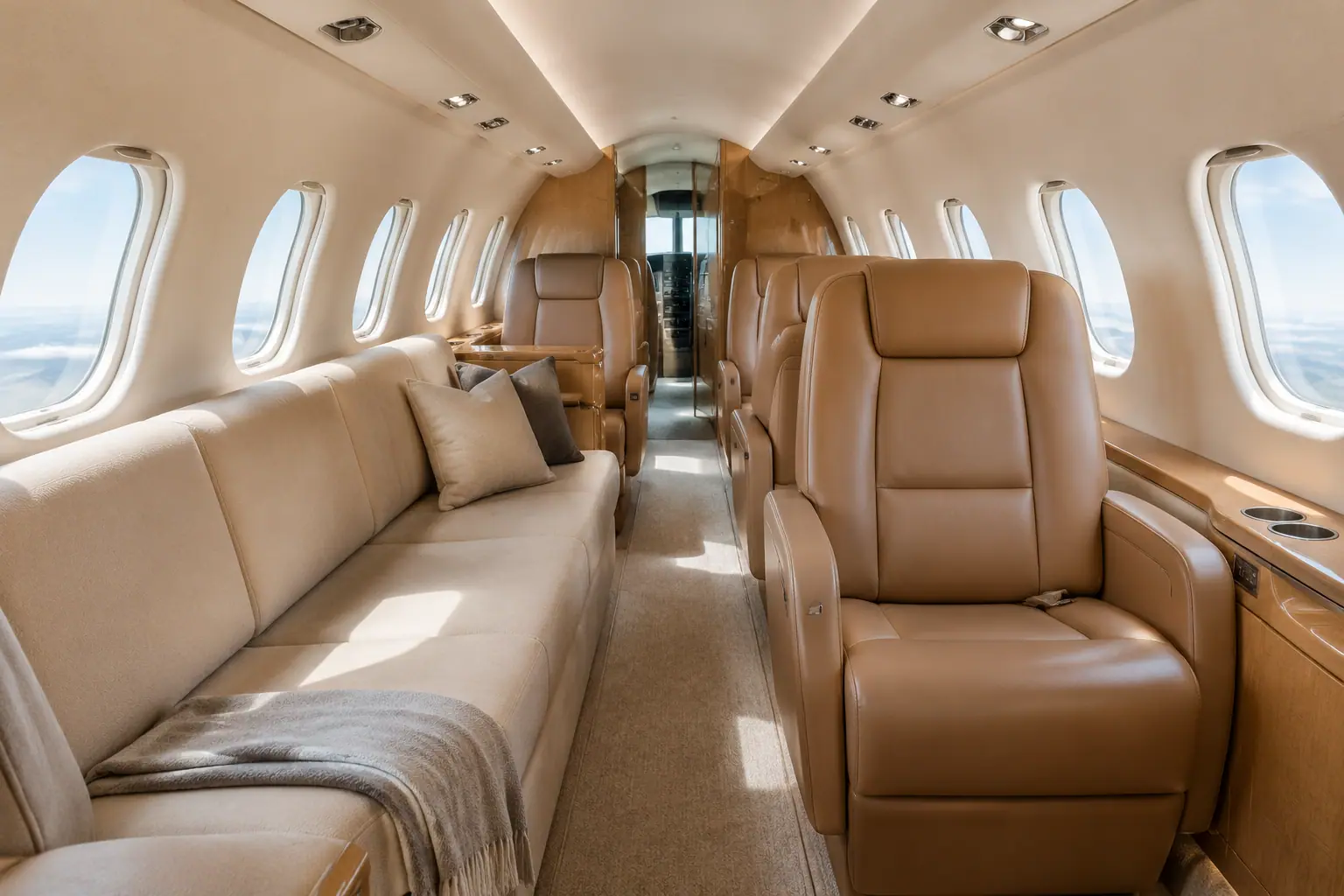
A light jet is the right fit for this 832 nm leg because it pairs a 2h 20m nonstop time with pricing that starts around $9,000. Aircraft like the HondaJet Elite II and Citation CJ4 Gen2 carry five to seven passengers and have the range for the trip. Midsize and super-midsize jets shave a few minutes but add thousands to the estimate; turboprops save money but stretch the flight past three hours.
If your party is small and luggage is modest, a light jet keeps the cost down without a fuel stop. For groups of eight or more, or travelers with ski bags and golf clubs, a midsize or super-midsize cabin makes more sense. Heavy jets only pay off when the schedule demands the widest cabin or the most baggage space.
Cessna Citation CJ4 Gen2
- 7 seats
- 451 kt cruise
- 2,165 nm range
Cabin 4 ft 9 in tall, 17 ft 4 in long. Baggage 71 cu ft.
Embraer Phenom 300E
- 7 seats
- 464 kt cruise
- 2,010 nm range
Cabin 4 ft 11 in tall, 17 ft 2 in long. Baggage 84 cu ft.

Leaving Chicago
Chicago Midway (KMDW) and Chicago Executive (KPWK) are the usual departure airports for this route, with longest runways of 6,522 ft and 5,001 ft respectively. Midway sits closer to the city; Executive draws business travelers from the northern suburbs. Your operator will assign a departure point based on aircraft performance and crew positioning.
If you depart from a smaller field, then expect a short positioning leg that can add to the estimate. Winter weather at either airport can prompt deicing delays, so build a little slack into the schedule between November and March.
Arriving in Austin
Austin Executive Airport (KEDC) in Pflugerville is the closest private-aviation field to central Austin, about 25 minutes from downtown in normal traffic, with a 6,025 ft runway. Austin Bergstrom (KAUS) has a 12,250 ft runway and the airline terminal, but general aviation arrivals use a separate FBO area.
If your final destination is Round Rock, Georgetown or the Domain, then KEDC is usually the quicker arrival. If you are heading south toward Buda or the airport corridor, KAUS may save a few minutes on the ground.
| Airport | Ident | Runway |
|---|---|---|
| Chicago Midway International Airport | KMDW / MDW | 6,522 ft |
| Chicago Executive Airport | KPWK / PWK | 5,001 ft |
| Austin Executive Airport | KEDC | 6,025 ft |
| Austin Bergstrom International Airport | KAUS / AUS | 12,250 ft |
When to book and what moves the price
Demand peaks around South by Southwest in March and the Formula 1 weekend in the fall, when Austin-bound aircraft and crews are tight and prices rise. Book those windows several weeks out, and expect light-jet availability to be the first to go. Spring and fall generally offer the best combination of weather and price.
If you can travel midweek, then you will usually see lower estimates than on Friday and Sunday, when business and leisure demand overlap. Same-day round trips are possible on this route but require a crew willing to wait in Austin; that waiting time is billable and can push a light-jet estimate toward the top of its range. Empty-leg flights sometimes appear when an operator repositions, so ask about them when you request quotes.
Private jet routes similar to Chicago to Austin
These 6 private jet city pairs span 656 to 945 nautical miles, with single-leg light jet estimates ranging from $7,000 to $15,000.
Questions about this route
How long is the private jet Chicago to Austin flight?
The trip covers 832 nautical miles, or 957 statute miles, and a light jet flies it nonstop in about 2h 20m. Midsize and super-midsize jets shave the time to roughly 2h 17m and 2h 10m, while a turboprop takes about 3h 13m. Winds aloft can shift these block times by a few minutes.
What does a private jet Chicago to Austin cost?
Estimates start around $9,000 for a light jet and run to about $13,500 at the top of that class. Midsize jets range from $12,000 to $18,000, super-midsize from $15,500 to $21,500 and heavy jets from $20,500 to $31,500. These are estimates, not quotes; actual pricing depends on aircraft, crew and date.
Which Austin airport do private jets use?
Most arrivals use Austin Executive Airport (KEDC) in Pflugerville, which has a 6,025 ft runway, or Austin Bergstrom (KAUS), with a 12,250 ft runway. KEDC is closer to downtown and the northern suburbs; KAUS may suit travelers continuing south or catching an airline connection. Your operator will confirm the FBO and arrival point.
Can I make a same-day round trip from Chicago to Austin?
Yes, a same-day round trip is feasible on this 832 nm route with a light or midsize jet, but the crew must wait in Austin while you conduct business. Waiting time is billed, so the round-trip estimate can land near the top of the class range. A one-way return the following day is often more economical.
What aircraft fly this route?
Light jets such as the HondaJet Elite II and Citation CJ4 Gen2 are the most common choice, carrying five to seven passengers with ranges of 1,550 and 2,165 nm. Midsize, super-midsize and heavy jets also serve the route, as do turboprops. The right pick depends on passenger count, baggage and schedule.
Who arranges the flight and who operates it?
As a charter broker, we act as your agent under DOT Part 295 and arrange the flight with an operator holding FAA Part 135 authority. That operator has operational control of the aircraft and crew. We compare quotes and handle the details; the operator is responsible for the flight itself. No international leg means no CBP clearance is needed.